SENSE AND SENSIBILITY
Directing: B+
Acting: B+
Writing: B+
Cinematography: A-
Editing: B+
It would seem that film and TV adaptations of Jane Austen novels—she only published seven, only four of them during her lifetime—are endless. But, this is really a testament to the enduring power of her work. Pride and Prejudice has of course gotten the most treatments, and Emma also had its fair share. But Sense and Sensibility, Austen’s debut novel, has only had two notable feature film adaptations, starting with the widely admired 1995 film starring and written by Emma Thompson, who won that film’s only Oscar for Best Adapted Screenplay. Now we have a new film adaptation, over thirty years later, and as with all adaptations, it reflects the time in which it was made as much as it reflects the time it depicts (in this case, early-19th century England).
One might wonder what point there is of another film adaptation, if the previous one was so great. I shall probably watch that one again soon, just out of sheer curiosity—but, it was likely the right choice not to have watched it right before this one. Making comparisons inevitable is unfair, and this Sense and Sensibility, directed by Georgia Oakley and adapted by Diana Reid (writing her first feature film script), works quite well on its own merits.
The world of this adaptation feels deeply lived in, and features all the charms one might want or expect from a Jane Austen story: a family of young women who are all victims of circumstance; a subtly villainous woman; fundamentally misjudged suitors; an eccentric aunt. The aunt in this case, one Mrs. Jennings, is played by an always-welcome Fiona Shaw, significantly livening up the proceedings.
There is something eternal about Austen’s stories, in which the women who make up the primary characters have their fortunes tied only to the fates of the men in their lives. Here we focus on three sisters: Elinor (Daisy Edgar-Jones); Marianne (Esmé Creed-Miles); and Margaret (Bodhi Rae Breathnach). Their father has died and left their mother, Mrs. Dashwood (Caitríona Balfe), relatively destitute, as his older child from a previous marriage, the sisters’ half-brother John (Tom Brooke, a somewhat inexplicably odd presence here), thus inherits the house. So it goes in this time: an uknown relative can take all the assets because inheritance only passes through the men.
And so, as always with these stories, the plot revolves around the women finding happiness by finding the right man with whom to secure their future. While Margaret gets a bit short shrift here, perhaps because she is youngest, both Elinor and Marianne are faced with suitors who have their own array of challenges: Edward (George MacKay) has clear affections for Elinor but is painfully shy about it, with more complicated reasons revealed further into the story; Colonel Brandon (Herbert Nordrum) is taken with Marianne, who is annoyed by his apparent lack of passion, and smitten by the apparent abundance of it in one John Willoughby (Frank Dillane).
I spent a lot of time watching Sense and Sensibility and thinking about its many narrative similarities to Pride and Prejudice, Jane Austen’s second novel and by far her most popular. It’s also true that this particular film adaptation of Sense and Sensibility has a fair amount in common with the Kiera Knightly-starring film adaptation of Pride & Prejudice from 2005. That is a better film than this one, just by virtue of its far higher pedigree, but not by a huge margin. By all accounts, the same could be said of the novels: Pride and Prejudice is better, but not by a wide margin.
These other stories largely exist for people wanting to continue their Jane Austen fix. At least in this adaptation, the characters are more lively than they are buttoned-up—particularly the women, who are well-rounded, multi-dimensional and distinct characters thanks both to the writing and the performances. In this film, the male characters as a general rule are serviceable but nowhere near as interesting. It’s always great to see women get their due, but they also deserve better men, don’t they?
This, I suppose, is the downside to the world of Jane Austen: the women can only pin their hopes and dreams on the men available to them, no matter how interesting or dynamic they may or may not be. With different actors, these men might seem more charismatic, but it’s also how they are written. But, whatever: it remains easy to get emotionally invested in these young women, their romantic entanglements and especially their relationships with each other. Such is the magic of Jane Austen, particularly when well enough adapted, which this is.
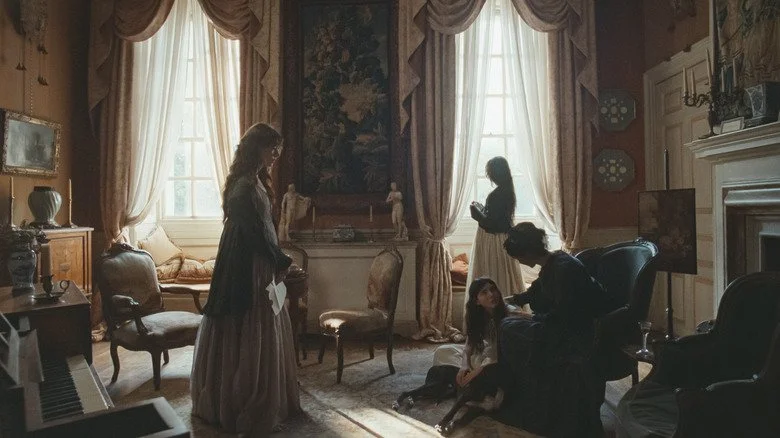
One of many stills from Sense and Sensibility that could double as a painting.
Overall: B+